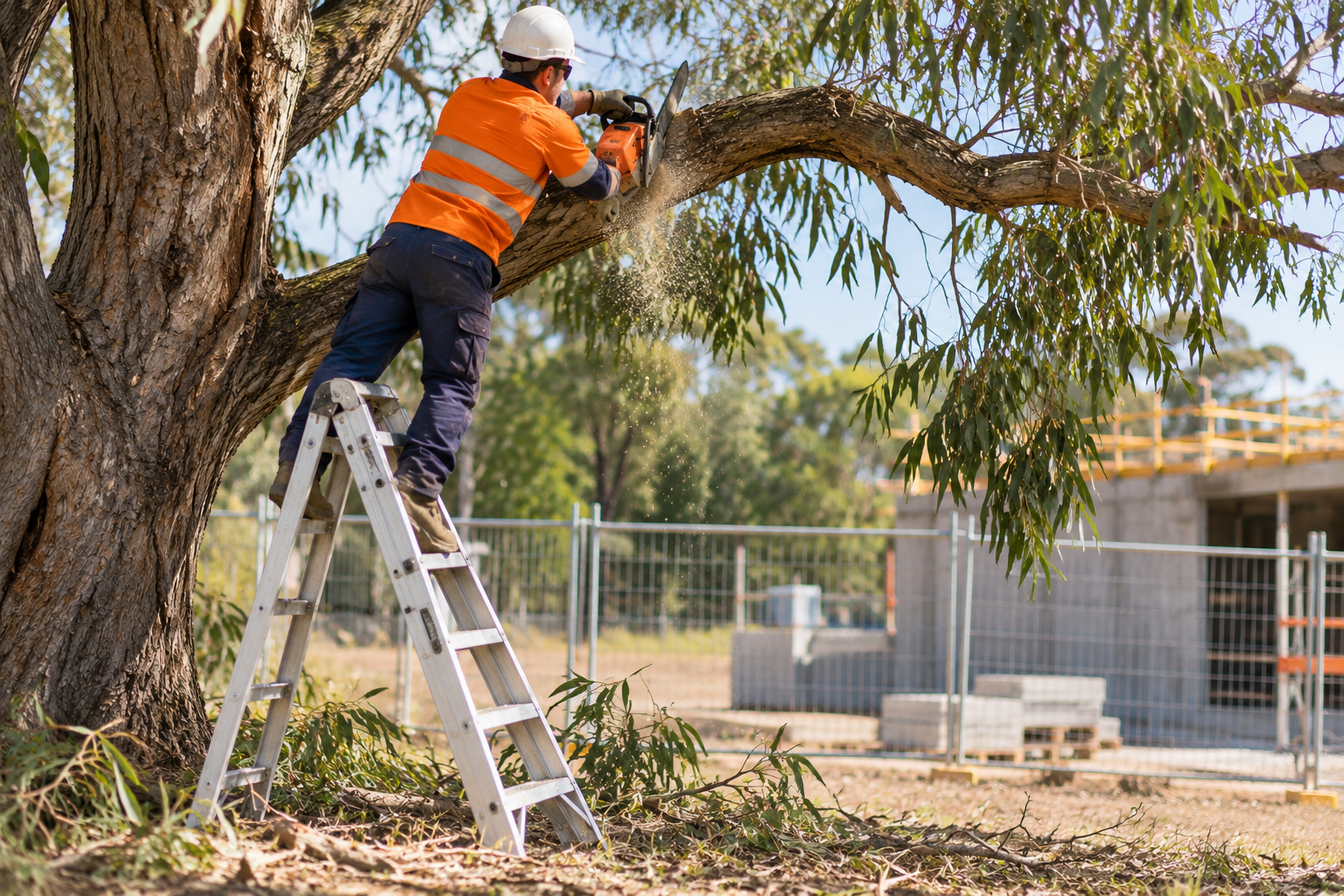
A Victorian employer has been fined $150,000 after a worker fell from a ladder while using a chainsaw to cut a tree branch at a construction site. The worker suffered a spinal column dislocation and was rendered paraplegic.
WorkSafe Victoria’s summary says the incident occurred on 7 March 2024. The employer was sentenced on 2 November 2026, and the regulator published its summary on 5 November 2026. The employer pleaded guilty and was convicted.
What happened
The employer had engaged a labour hire provider to supply workers to the site. A tree branch needed to be cut to provide access for a concrete truck. The worker, who was not a qualified arborist or tree-removal specialist, used a chainsaw while standing high on a 3.7-metre A-frame ladder.
As the worker cut another section of the branch, it swung down and struck the ladder. The worker fell head first to the ground. The risks identified in the regulator’s summary included being struck by a branch and falling from height.
The summary says there had been no discussion about how the worker would access the branch or the safety issues involved. The supervisor did not prepare a Safe Work Method Statement (SWMS) for the task, and no temporary work platform, such as an elevated work platform, had been arranged.
What the court found
According to WorkSafe Victoria, the court found the employer had failed to reduce the risks through its systems of work. The identified failures included not engaging a qualified arborist or tree-removal specialist, and not providing an alternative such as a temporary work platform or a telescopic long chainsaw to address the fall risk. The task was identified as high-risk construction work, and the employer had not prepared a SWMS before it began.
The court described the offending as a serious example and a substantial departure from the statutory duty. It also noted that the offences were risk-based: the seriousness was assessed by the extent of the failure to meet the duty, not simply by the outcome. The victim impact statements reflected the severe effects on the worker and family.
The employer was fined $150,000 and ordered to pay $13,335 in costs. The regulator’s summary says that, under section 6AAA of the Sentencing Act 1991, the court stated that but for the guilty plea it would have imposed a fine of $220,000. That is the stated counterfactual sentence, not an additional penalty.
WorkSafe Victoria also reports that the court took account of mitigating factors, including the employer’s lack of prior convictions, cooperation with the regulator, safety improvements made after the incident, small-business status and delay.
Why this matters to managers
The task arose from a site-access need, but it involved cutting a substantial branch at height with a chainsaw. The findings highlight the importance of treating that change in work as a task requiring its own planning—not relying on a worker’s general experience or on the immediate project deadline.
For managers, the practical lesson is to decide who is competent to perform the work, how they will reach it, and how the branch and fall hazards will be controlled before work starts. If the task changes or an unexpected obstacle emerges, pause and review the plan rather than allowing an informal arrangement to become the work method.
What safety managers and supervisors should take note of
- Assess the task before assigning it. Identify branch movement, falling objects and work-at-height risks. Consider whether the work should be undertaken by a qualified arborist or tree-removal specialist.
- Choose and provide a suitable access method. The findings identified a temporary work platform, such as an EWP, or a telescopic long chainsaw as options for addressing the fall risk. Do not assume a ladder is suitable for chainsaw work at height.
- Prepare the required task documentation before work begins. For high-risk construction work, confirm the SWMS is prepared, understood by the people doing the work and relevant to the actual method and equipment.
- Make the plan and responsibilities clear. The supervisor should confirm who is authorised and competent to do the task, what controls and equipment are required, and who will check those arrangements before work starts.
- Record changes and reassess. If site access, the work method or conditions change, stop and review the risk controls and documentation before continuing.
- Check that the system works in practice. A written plan is only useful if the required specialist, equipment and supervision are available at the workplace.
Source information
- Regulator/source: WorkSafe Victoria
- Source type: Regulator summary
- Decision date: 2 November 2026
- Source limitation: No court judgment, tribunal decision or sentencing remarks were attached to the available source material. Findings and sentencing details above are reported as described in the regulator’s summary.
- Source: Official source document