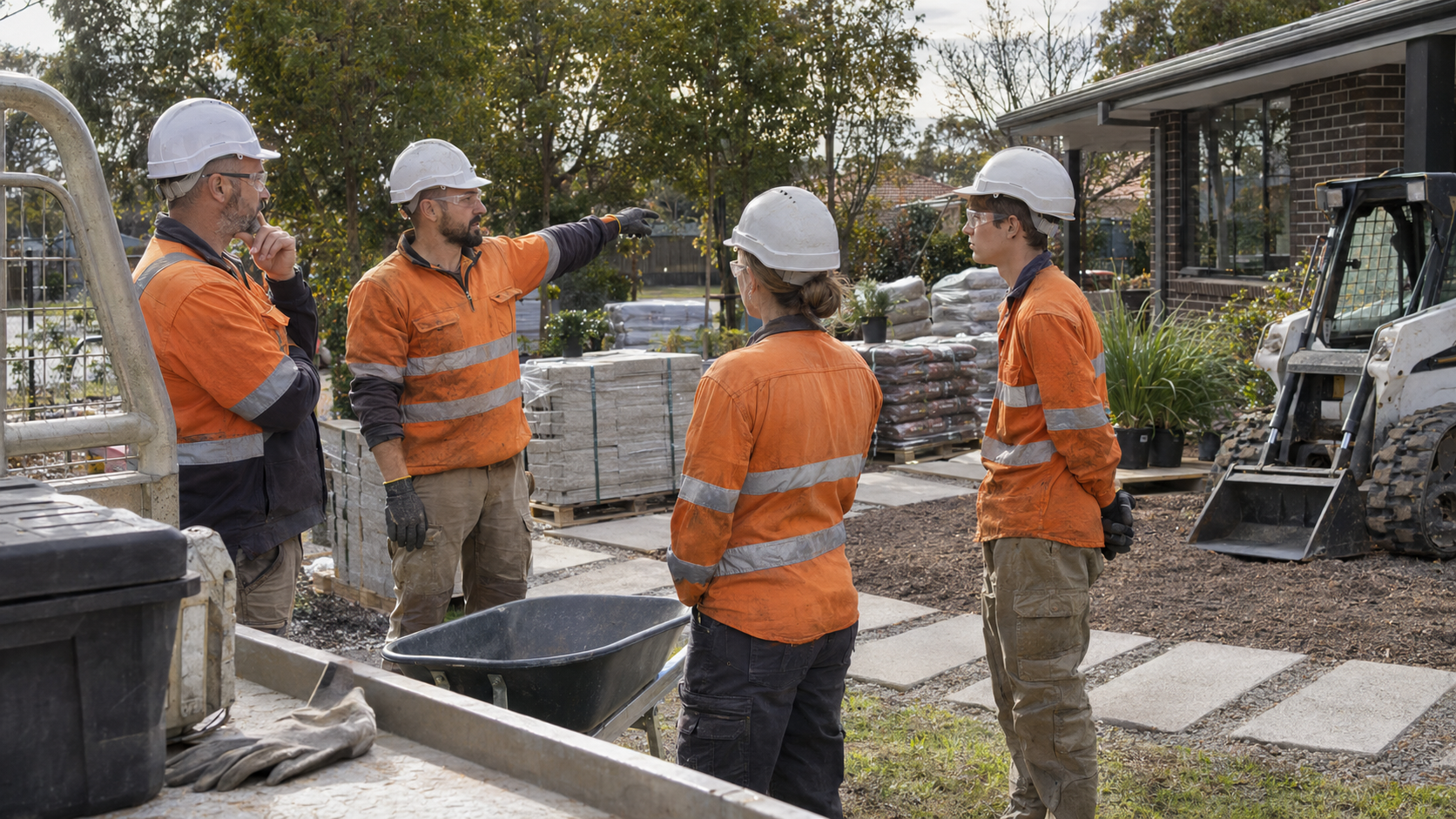
A safety poster can remind people what matters. It cannot decide how a crew will move a heavy stack of pavers across uneven ground, whether a compact loader is suitable for the access route, or what happens when the plan stops working.
Those decisions show what a business’s safety culture looks like in practice.
For a small landscaping crew, that culture is visible before the ute is unloaded: in whether the owner asks workers what they can see, whether the task is planned around the real site, and whether concerns lead to a change in the work.
Start with the job people will actually do
A manual handling plan should reflect the materials, distances, ground conditions and equipment involved. Pavers vary in size and weight. A route that looks clear from the street may include a slope, soft ground, steps or a narrow gate. Weather, fatigue and the experience of the crew can also affect how the task should be done.
Before work begins, walk the route with the people doing the job. Discuss:
- where materials will be unloaded and stored
- how far they need to be moved and over what surfaces
- whether mechanical assistance is suitable and can reach the work area
- what happens if access, weather or site conditions change
- who will stop the task and reassess it if the plan is no longer workable.
Safe Work Australia’s guidance on hazardous manual tasks recommends identifying and managing risks from tasks such as lifting, pushing, pulling and carrying. Its risk management model code describes a process for identifying hazards, assessing risks, choosing controls and checking whether they work. Check with the relevant local regulator about which model codes have legal effect in your state or territory.
Use the crew’s knowledge
A pre-start conversation is useful when it is about the work in front of the crew—not just a routine reading of general safety rules.
Ask workers and the apprentice what could make the task difficult or unsafe. They may know that a path is narrower than it appears, the pavers are awkward to grip, or the loader cannot safely reach the intended position. Give them time to explain, and adjust the plan where appropriate.
Consultation is more than asking for comments after the decision has already been made. Safe Work Australia says workers should have a reasonable opportunity to express their views, have those views considered and be told the outcome. See its guidance on WHS consultation duties.
Make the safe method practical
If the plan depends on everyone manually carrying heavy or awkward pavers over a long distance, consider whether the materials can be placed closer to the work area or moved with suitable mechanical assistance. A team lift may help with some items, but it does not automatically make a task safe. The crew still needs a manageable load, a clear route, enough space and a way to coordinate the movement.
Equipment also needs to suit the task and site. A compact loader may reduce manual handling, but it brings its own operating risks. Plan the route, loading and unloading, separation from people on foot, and who is authorised to operate it.
Show that speaking up changes something
Workers are more likely to raise concerns when they see that the business responds constructively. If someone reports that a load is too awkward, the route is unsafe or the equipment is not suitable, pause and address the issue. Explain any decision to continue and the controls that will be used.
A concern that gets ignored teaches the crew that speaking up is pointless. A concern that leads to a better method shows that safety is part of how the work is managed.
Check the plan during the job
Conditions can change once work begins. Materials may be heavier than expected, the access route may become slippery, or the equipment may not fit where planned. Supervisors should check whether the agreed controls are being used and invite workers to raise problems as they arise.
At the end of the job, take a few minutes to ask what worked and what should change next time. Record actions that need follow-up, assign someone to complete them and check that they were done. A briefing without follow-through is just another conversation.
Posters and written procedures can support a safe workplace. The everyday test is whether managers plan the actual task, workers can influence the method, and concerns lead to action. That is where safety culture becomes visible.
This article provides general information, not legal advice. Businesses should assess their own work, workers, equipment and site conditions, and check the requirements that apply in their jurisdiction.